Showing posts with label bakelite. Show all posts

Friday, February 7, 2014

The Dreaded "F" Word - Fakelite!

In the last 4 years I have been collecting Bakelite, I been duped a couple of times with "fakelite" posing as Bakelite. One of those purchases took place in an antique mall in South Florida.  I bought a heavy, smooth rootbeer bangle that was listed and priced as Bakelite but it was in fact, fake. I was just starting to collect and still unaware of how to properly tell if a piece was real or not.

What is Fakelite? Fakelite is imitation Bakelite that can have the same look, weight, feel, detailing, colors, marbling, and carving style as real, authentic Bakelite pieces. I have heard from others that a few fakelite pieces can even smell like Bakelite!

I wanted to add pictures showing examples of fakelite but I do not want to get in trouble. Most of the Fakelite I encounter has been found on Etsy and eBay and if I post someone's listing pictures, I may find myself in hot water.

So here are some pictures of REAL Bakelite from my collection to familiarize yourself:


Notice the carvings are basic, not super crazy detailed? See the marbling on the end-of-day pieces? See the colors?

Sadly, I have been finding A LOT of fakelite on Etsy recently.  The fakelite typically in question is usually a bangle with overly ornate carvings and the colors are too marbled.  The bangles are too thick, way too heavy, and the colors are odd. A while back, I saw a bangle that went from red, yellow to green! So fake! What really tips me off when a bangle is fake is the type of carving. I have seen carved dolphins with big bubbles and sea life!

Real Bakelite usually has more simple carvings. You may find real pieces with cut-outs, rhinestones, round grooves that encircle an entire bangle (like a record), leaves, rose petals, etc. But dolphins? FAKE!!!

What burns my biscuits about fakelite is that some sellers will claim a piece passed all the tests (friction, 409, hot water, simichrome, etc) and they will charge Bakelite prices. However, if a piece is listed as 'fakelite' and the price reflects that, then great! I may even buy it if it's cute! But when fakelite is passed off as actual Bakelite, that is wrong!

I recently found a few links for helping distinguish fakelite from Bakelite:

http://www.realorrepro.com/article/Is-it-Bakelite

http://www.angelfire.com/ca3/gale/

And here is a fabulous post from 2012 by amazing vintage blogger, Brittany, of Va-Voom Vintage:

http://www.vavoomvintageblog.com/2012/03/how-to-identify-bakelite.html

I wrote this post in the hopes of helping others who may be in the infant stages of starting their own Bakelite collections.  If I can give just one bit of advice, I would suggest looking for Bakelite in person especially before venturing online to buy. Many antique malls, antique stores, car boot sales, charity shops, and swap meets will have a few bits of authentic Bakelite for sale. Familiarize yourself with the colors, the smell (do a friction test with your fingers and then smell your fingers), the weight, the sound (Bakelite should have a heavy clunk not a light "tink tink"), marbling, and the carvings. Also, the inside of a real bangle or the back of earrings, brooches, etc will be seamless. There will be no pour marks or branding.  The surface may have a patina or age spots. Learn the proper characteristics so when you shop online or visit the antique mall, you will have a better determination of what to buy and what to avoid.

Wednesday, May 2, 2012

(BOTD) Bakelite of the Day!

Just for fun, I decided to do a "BOTD" i.e. Bakelite of the Day post! I normally wear bakelite in some form every day, usually as bracelets or earrings.

In the last two years, I have been building my bakelite collection. So far, I have spacers, a few carved bangles, some end-of-day pieces, a smattering of smooth bracelets, and two pairs of carved earrings. I want more carved bangles and a beaded necklace or two! I would have more but as we all know, bakelite is not cheap!

In addition to my bakelite obsession, I also love and make resin jewelry. I use pour resin by Castin' Craft mixed with glitter, beads, and/or opal flake. Initially, I just made pendants but in the last few months, I have branched out to making earrings too!

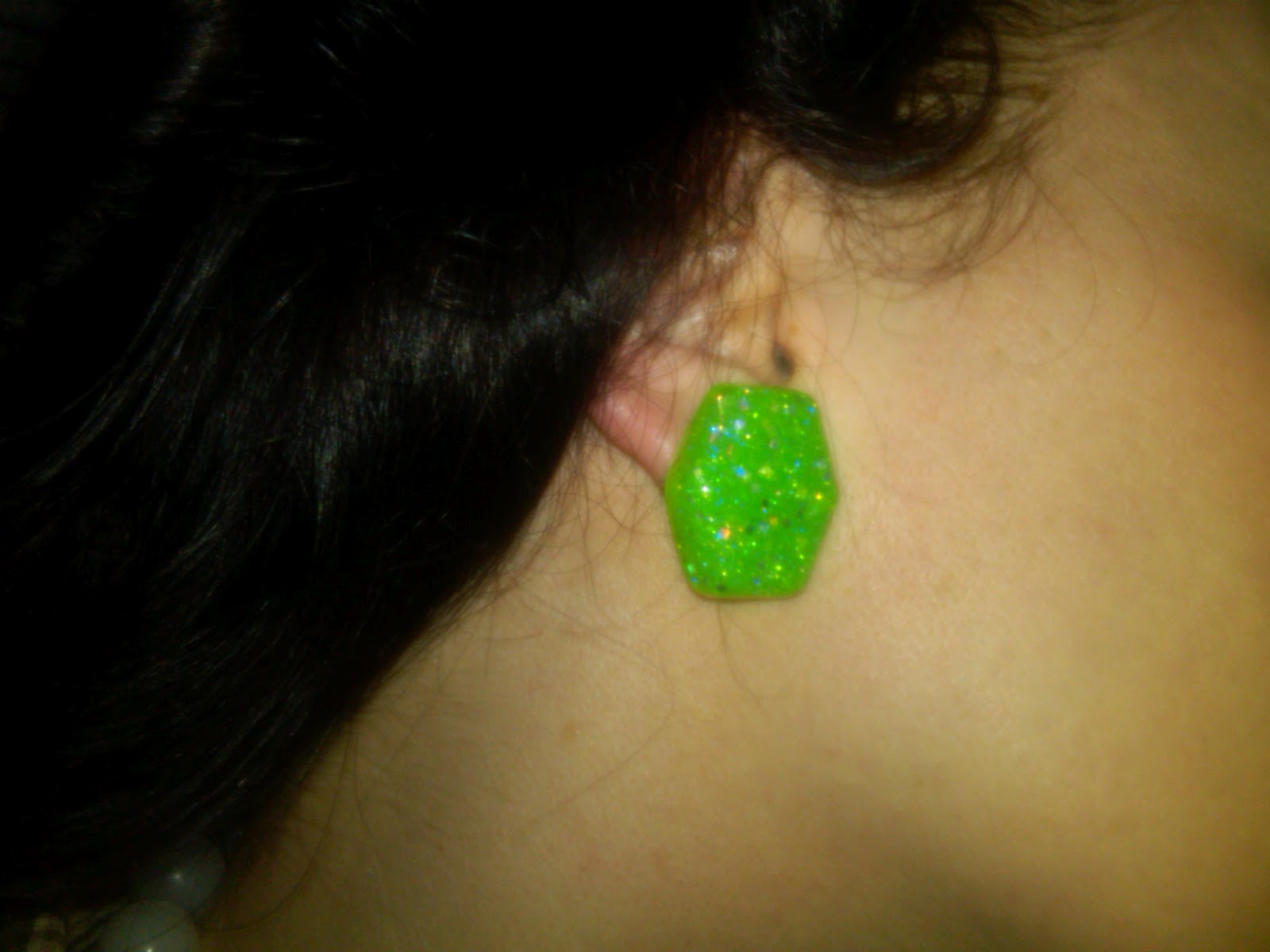
Here is one of the earrings I am wearing today! I made them with resin, green glitter, and mini square silver glitter!
After pouring and setting the mold, I allowed the mixture to set and when it was cured (two days), I popped the resin out of the mold, coated the surface with a clear, protective polymer, and attached the earring posts! Viola! They were done and ready to wear!

Thursday, August 5, 2010

Bakelite Testing


Even though I have been collecting vintage jewelry for many years, it is only recently that I have turned to collecting Bakelite jewelry. Bakelite is an early form of plastic created by a Belgian chemist in the early 20th century. Bakelite was made into costume jewelry, hair accessories, and even radio facades. Unlike moonglow and lucite, bakelite is heavier and can often have an aged look or patina to its surface. Another key difference between bakelite and most plastics is the price! Bakelite is usually very expensive. The red spacer above cost me $18 USD and I recently bought another butterscotch colored spacer for about 20 USD. I have seen thicker bangles with intricate carvings go for 180 USD and up!

So, since most vintage collectors want the real deal, how do they know what they are buying is actually bakelite? Most sellers are honest, some are unaware of what constitutes the real deal, and some are out to "pull a fast one" on unsuspecting shoppers. So, what is a vintage girl to do?

There are several ways to test bakelite. Some methods involve using 409 and a q-tip, using Simichrome metal polish, hot water soaking, using Scrubbing Bubbles cleaner, hot needles (not recommended), listening for a distinctive "clunk" sound, and friction.

I am sure that pulling out cleaners and polish in the middle of the antique mall is not going to go over well with sellers. You could ruin their merchandise or just simply end up looking weird. I have found that friction testing and listening for the clunk are the best ways to test for bakelite authenticity.

When using the friction method, gently rub a small section of the bakelite until it feels warm. Smell your fingers and the bakelite. You should be able to detect the scent of formaldehyde. If you rub a piece of standard lucite or basic plastic, you will not detect ANY scent.

If you tap two pieces of bakelite together (this really works for bangles and spacers), you should be able to hear a heavy, solid clunk. If the pieces are plastic, not only will they feel lighter, they will have a light "tick" not a "clunk."

Another important characteristic of bakelite bangles and spacers is how they are usually "seamless." Unlike most plastics, bakelite bangles do not have seams in the middle.

I am still learning about bakelite and the more I learn, I will share with you all. I am having fun building my wares but boy, it this hard on my wallet!

So, do you like bakelite? Are you a collector? What are your tried-and-true methods for ensuring your investment is the 'real McCoy?'